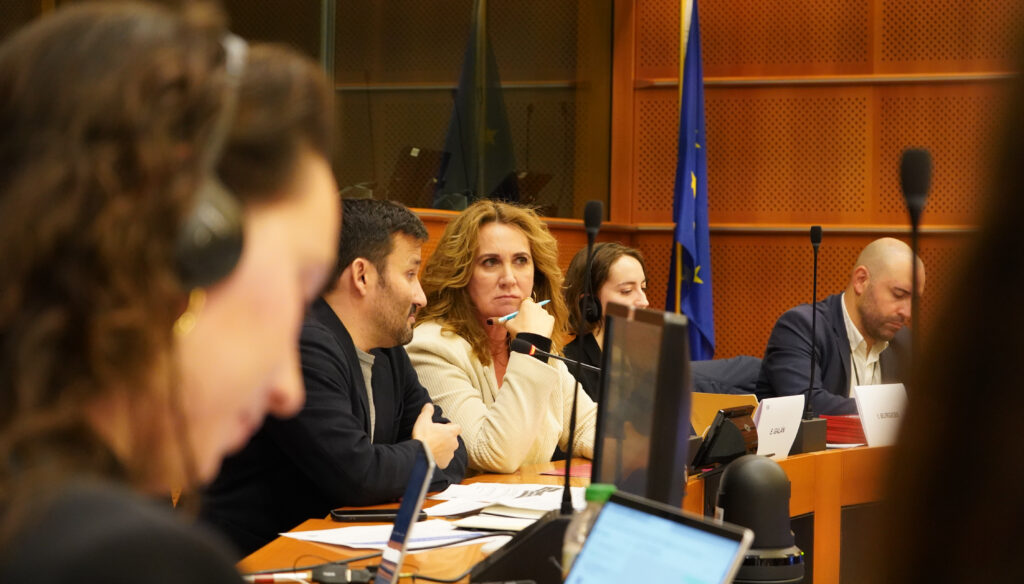
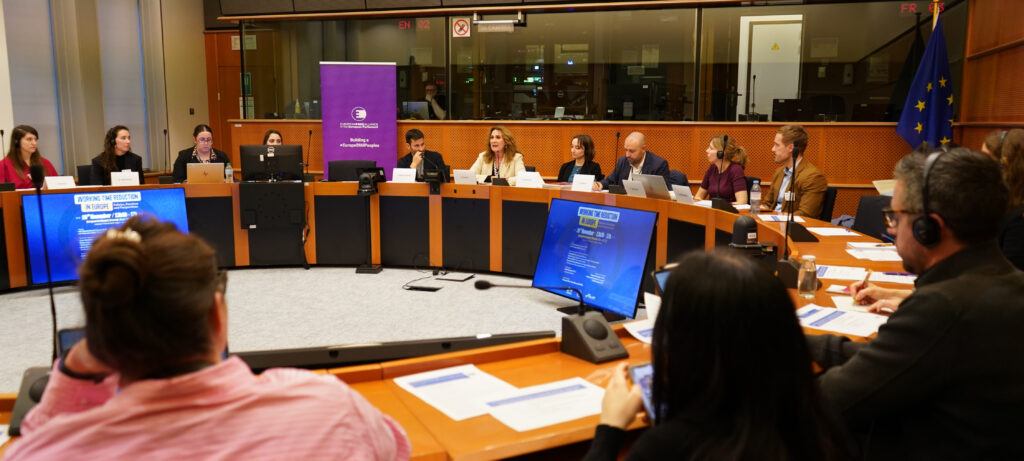
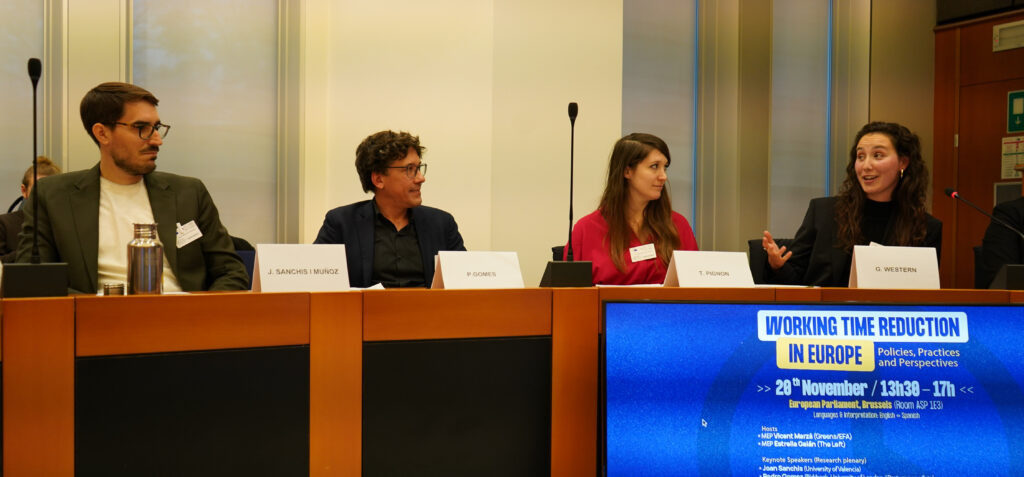
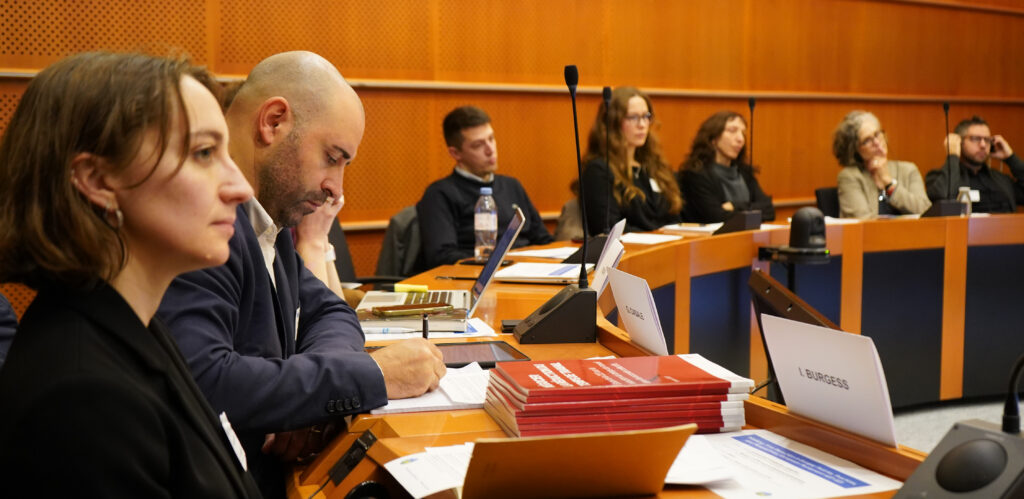
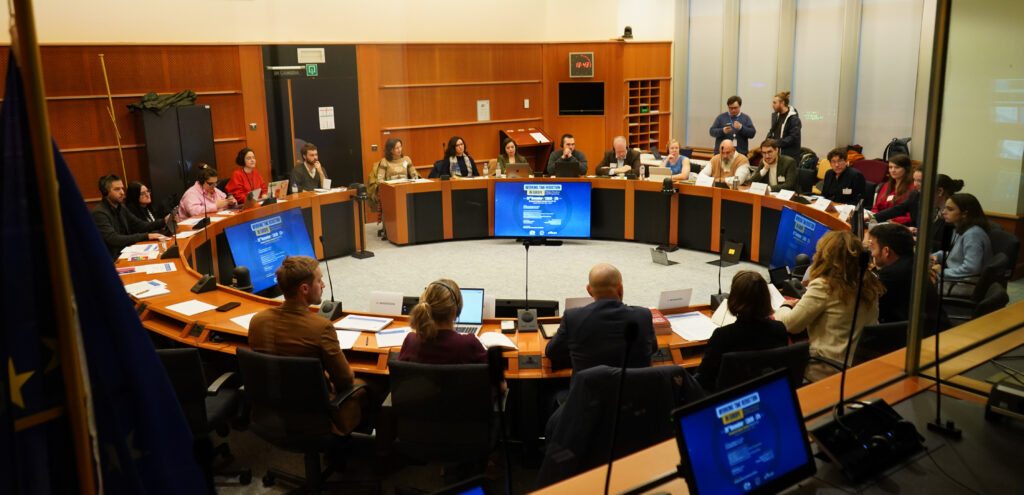
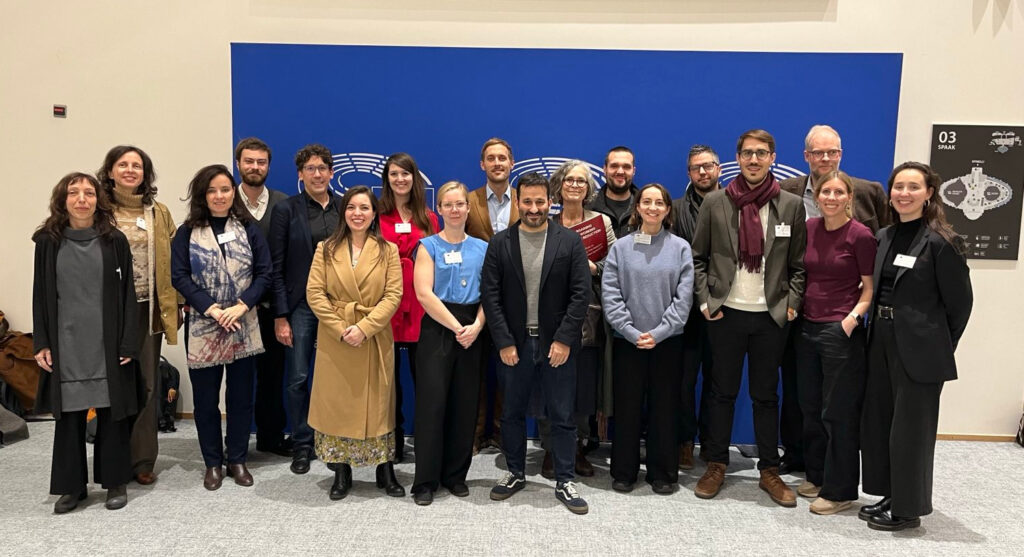
On November 20th 2025, The European Work-Time Network participated in a special event in the European Parliament.
This public event, which was hosted by the EFA-Green Group in European Parliament and supported by the European Work-Time Network, brought together researchers, trade unions, civil society, and policymakers to explore the promise of working time reduction as a path toward more meaningful work, sustainability, and economic justice.
The event was hosted by MEP Vicent Marzà (Greens/EFA) and MEP Estrella Galán (The Left). At the event, policy experts and trade union organisers alike discussed trials of 4 day work week world-wide and how policy can support the 4 day week:
- Tatiana Pignon (Autonomy Institute)
- Joan Sanchis (University of Valencia)
- Pedro Gomes (University of Birkbeck)
- Grace Western (European Work-Time Network/Autonomy Institute)
- Enric Nomdedéu Biosca (Former Regional Deputy Minister for Employment, Valencian Government)
- India Burgess (European Work-Time Network/Autonomy Institute)
- Yvette Becker (Netherlands Trade Union Confederation)
- Giovanni Casale (European Trade Union Confederation)
- Hampus Andersson (Kommunal, Swedish Municipal Workers’ Union)
For the event, the Work-Time Network put together a few key takeaways:
Key Insights on Working Time Reduction (WTR):
In recent years, a number of pilot programmes and policies to experiment with the impact of shorter working hours have been deployed across Europe and elsewhere, allowing researchers to assess the impact of these policies on different spheres. Here are the key findings.
1. Work Time Reduction and the Wellbeing of Workers
The analysis of multiple pilots has shown that work time reduction improves the health and wellbeing of workers, with consistent results despite important differences in country contexts, industries, working conditions, and implementation models.
Statistically significant improvements are found in both physical and mental health outcomes,in particular, (1) measures of stress, anxiety and burnout all reduce significantly; (2) sleep improves, both in quality and in quantity; (3) positive emotions go up and negative emotions go down following a reduction in working time.
Workers also report (4) increased job satisfaction and a better general experience of their working lives. These impacts are dependent on policy design and implementation specifics, particularly the workplace adaptations created to support a shorter working schedule.
Benefits extend outside of work as well. Workers report (5) better life satisfaction overall, with reduced work-family conflict, more time for caring and domestic responsibilities, and more time for hobbies and personal interests. Having more time away from paid work can also generate (6) an increased sense of freedom, particularly for categories of the population that tend to experience higher pressures outside of paid work, such as (7) women or disabled workers. Work time reduction can also translate into (8) direct financial savings for workers and their families, through saving on childcare or commuting costs for example.
Beyond individual workers themselves, (9) families and communities can benefit through better quality relationships, an increased ability to undertake unpaid work such as care or volunteering, as well as an increased opportunity to engage in community and social activities.
2. Work Time Reduction and Competitiveness
Firms across multiple sectors and countries are trialling and adopting shorter working weeks without cutting wages as a deliberate business strategy. While many other firms remain apprehensive about experimenting with new ways of organising work, existing research has identified several mechanisms through which these pioneering firms have benefited.
Some mechanisms arise directly from the effects on workers: (1) better-rested employees work with more energy and make fewer mistakes; (2) absenteeism falls, reducing the financial and operational costs associated with temporary staff, rescheduling shifts, and reorganising teams; (3) staff turnover declines, lowering recruitment and training costs.
Other mechanisms relate to how shorter working weeks are implemented in practice: (4) formats are chosen intelligently and adapted to the needs of each sector and organisation; (5) changes in work organisation and processes—often supported by worker involvement—lead to the adoption of best practices and new technologies, contributing to productivity improvements; (6) reduction of other costs, for example in energy use or minor employee benefits. Most companies do not need to recruit additional staff.
There are successful examples in restaurants, manufacturing, healthcare, call centres, nurseries, care homes, and retail. These sectors face high levels of absenteeism, staff turnover, and burnout. While implementation is more challenging in such contexts, the potential gains for firms are greater.
These mechanisms combined increase productivity per hour sufficiently to offset the reduction in hours worked. However, this outcome is not automatic: it requires coordinated effort and commitment from both managers and workers during the implementation. Moreover, existing research cannot yet determine the extent to which these benefits would generalise if shorter working weeks were adopted more widely.
3. Work Time Reduction and the Triple Transition
The European Commission’s Triple Transition aims to integrate the digital, green, and social dimensions as key pillars for future development. WTR initiatives contribute to this agenda by raising productivity and efficiency, advancing more sustainable lifestyles, and promoting social justice. Beside their positive effects on workers and firms, WTR initiatives in Europe have shown promising results at macro level in environmental, social, and economic aspects.
Countries’ ecological footprint is positively associated with average working hours through different channels. (1) Commuting time is significantly reduced if the working week is shortened. Moreover, more diverse working schedules can reduce traffic in peak times, and therefore lower carbon emissions. (2) Lower-impact activities tend to be favored when people have more available time.
Shorter working hours can be a powerful tool for promoting (3) a more equitable distribution of care work between men and women. Data from several pilots, including the UK and Portugal, show that men on shorter working hour schedules assume more responsibilities at home. Moreover, women and parents with children have a higher interest and perceived value in WTR initiatives. A wider societal WTR could contribute to (4) increasing fertility across Europe and (5) improving public health.
WTR can have broader macroeconomic implications, (6) stimulating aggregate demand both through increased hourly salaries and increased leisure time, in particular. WTR can contribute to (7) fostering innovation through promoting new smarter ways of working, as well as hybrid entrepreneurship (starting a company in one’s free time). Finally, it can (8) reduce social unrest with a fairer distribution of work and income, and thus (9) advance a more democratic society allowing time for increased political participation and volunteering for social causes.
Policy Proposals
- Promote experimentation through public–backed national trials both in the public and private sector, financing technical assistance for participating organisations and funding research conducted under academic leadership to ensure the highest methodological standards.
- Deploy European Commission resources to support – operationally or financially – companies, unions and workers that voluntarily are willing to advance work time reduction initiatives (guidance, tools, fiscal benefits, etc.).
- Through sectoral collective agreements or a Regulation, mandate work time reductions in consolidated sectors, for example sectors where technological advancements are leading to rapid and sizable destruction of jobs, sectors where working conditions are particularly difficult, or for multinationals operating in multiple European countries.
The above is available as a PDF.
A selection of photos from the event can be found below.