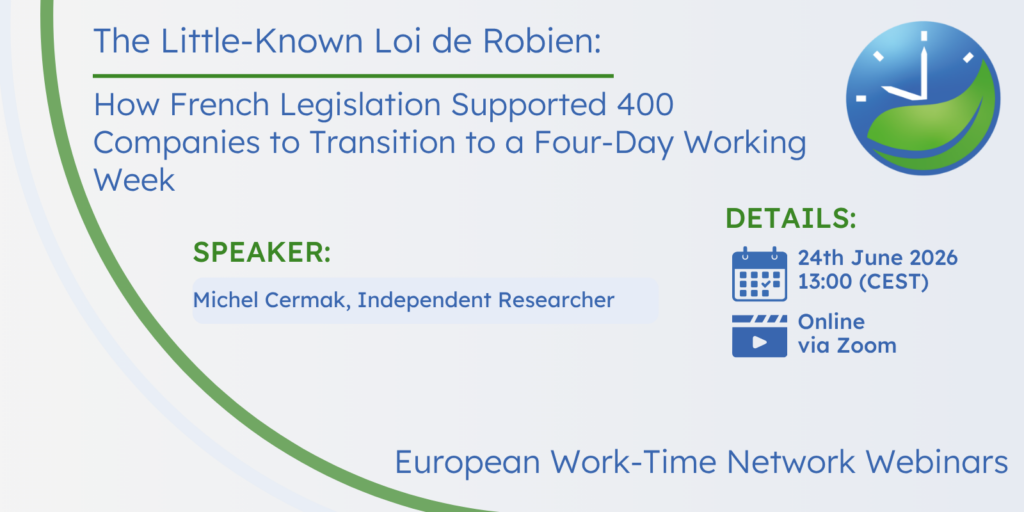
For this European Work-Time Network webinar, we were joined by Michel Cermak who will talk about the little-known Loi de Robien, a piece of French 4-day week legislation that supported 400 companies to transition.
The event was hosted online at 1pm Brussels time on Wednesday 24th June. Our speaker delivered a short presentation on the subject, followed by an audience Q&A.
How many of us are familiar with the Loi de Robien? Enacted in 1996 as a legislative response to rising structural unemployment, this law offers a compelling case study at the intersection of labour law, macroeconomic policy, and organisational change.
What is the relationship between working time reduction and job creation?
The relationship between working time reduction and job creation remains a contested terrain in labour economics. Much of the contemporary debate has centred on the 100-80-100 model — full pay, reduced hours, increased productivity. Yet as Professor Juliet Schor argued in her widely cited TED Talk, this paradigm has limitations: compressing the same workload into fewer hours is neither universally desirable nor feasible. For teachers, healthcare workers, or flight attendants, the issue is not intensification but relief. This point was illustrated by the Gothenburg experiment in elder care, where a shift to a six-hour working day was accompanied by the recruitment of additional staff to cover hours.
1996: The Loi de Robien was introduced
The Loi de Robien offered a different framework. Companies were eligible for a reduction in social contribution only if they both reduced working hours and created new jobs. Of the 2,953 companies that used the law, 482 adopted its most advanced provision. This was a working week reduced from 39 hours to 33 hours 30 minutes or less, paired with a minimum 10% increase in headcount. Crucially, because new employees also contributed to social security, the net fiscal impact on public finances was largely offset. This legislation has been largely forgotten in part because it was replaced by the more widely known « 35 hour week » Aubry laws.
Watch the webinar
In this webinar, Michel Cermak:
- Reconstructs the legislative history of the Loi de Robien
- Surveys the limited but instructive body of research published on its implementation
- Traces the trajectories of some of the companies that embraced its most ambitious provisions
Michel co-authored the book « Mode d’emploi pour la semaine de 4 jours en Belgique ». He worked with MEP Pierre Larrouturou at the European Parliament, creating an EU pilot project on working time reduction and the 4 day week.
Watch our previous webinars on our Events page.