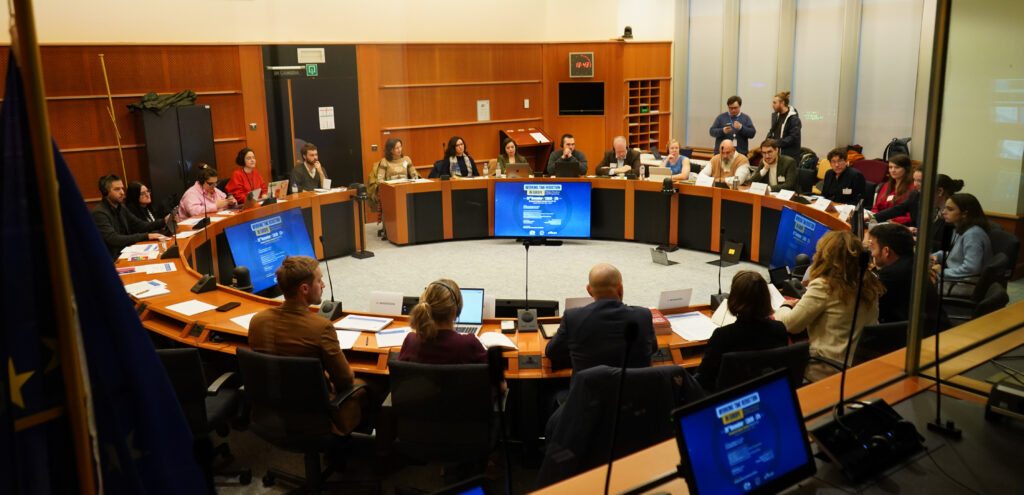
Founded by ATTAC (Germany) and Collectif Roosevelt (France) in 2013, “The European Network for the Fair Sharing of Working Time” originated as an informal structure open to representatives of organizations, experts, and activists.
Currently, members of our Network includes multiple organizations, including trade unions, NGOs, citizen movements, scientists, policymakers, and members of the European Parliament from twelve countries: France, Germany, Belgium, United Kingdom, The Netherlands, Norway, Sweden, Spain, Austria, Hungary, Slovenia, and Poland.
Current Status
We are currently holding monthly webinars to discuss working-time reduction policies and organising our upcoming 2026 annual meeting.
Trajectory
- Constitution of the Network
November 19th, 2013 European Center of Youth (Strasbourg)
The constitution of the network started in the format of a public seminar with 50 participants.
We heard presentations from 4 MEPs, 3 researchers, and 2 NGOs (Attac Germany and Collectif Roosevelt).
2. Building a Common Strategy
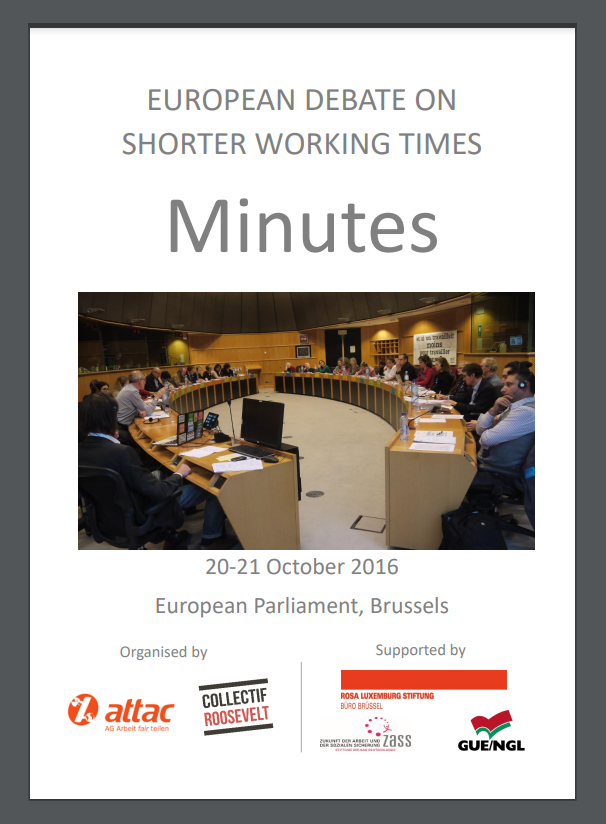
October 20th-21st, 2016 European Parliament (Brussels)
After a gap period, the constitution of the Network continued with a format change. We focused on creating links between key organisations with a private meeting to develop common strategies.
35 participants from 7 countries were present: unions, NGOs, policymakers, and scientists. Attac Germany and Collectif Roosevelt established a partnership with the Rosa Luxembourg Foundation and the Office of the MEP Thomas Händel to cover the new requirements of this format.
3. Establishing Working Groups
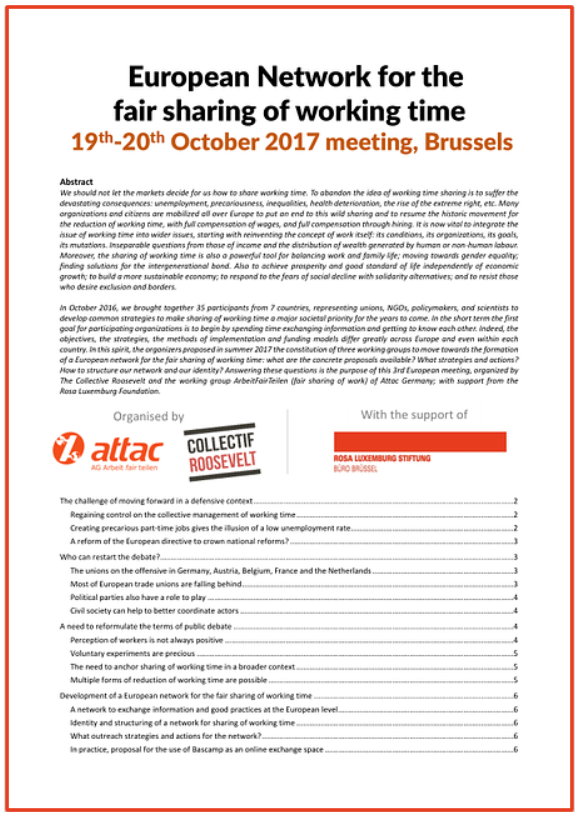
October 17th-18th, 2017 RLS Office (Brussels)
Three working groups were created to make the Network move forward between the conferences and address key questions: What are the concrete proposals available? What strategies and actions? How to structure our Network and our identity?
4. Aligning Objectives
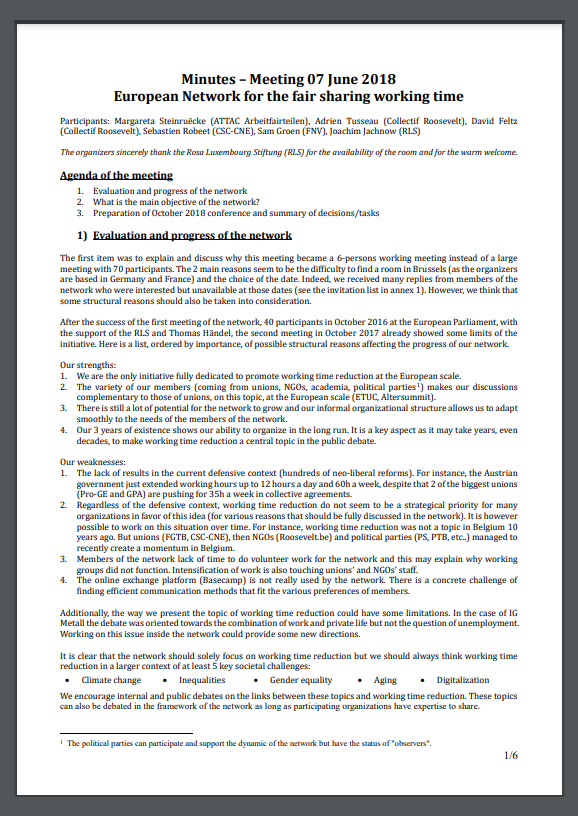
June 7th, 2018 FGTB Office (Brussels)
The three objectives of this meeting were the following. First, to evaluate the progress of the network. Second, to better define the main objective of the network. Third, to prepare for the October conference.
5. Assessing our Progress
October 25th-26th, 2018
Considering information exchange as the main driver of the network, the 2018 meeting focused on presentations from key organisations to map the experimentations across Europe and on identifying our main problems and successes so that members can better know how to help each other.
The Network starts a tradition of an annual meeting in Brussels.
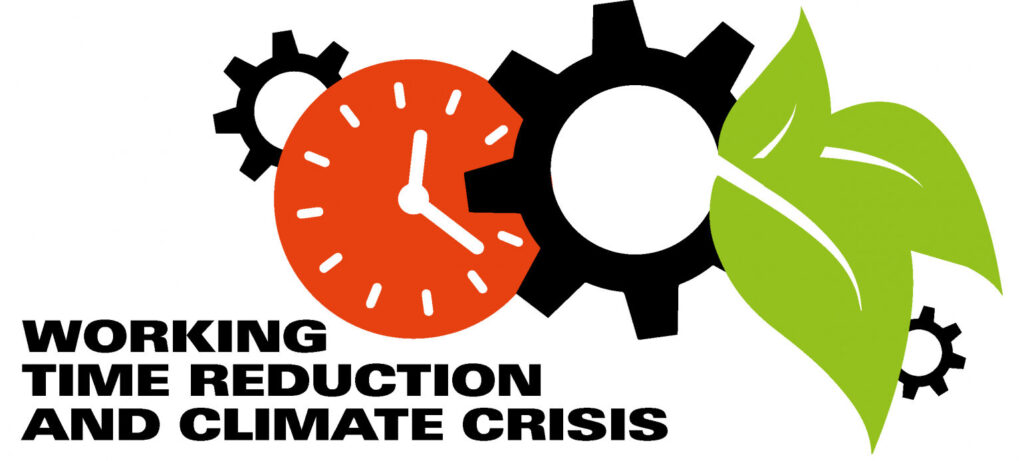
6. 2020 Conference: Working time reduction and climate crisis
October 22nd & 23rd, 2020.
At our 2020 conference, we discussed the potential contribution of working time reduction to the socio-ecological transition, the role of reduced working time in addressing climate change and its place in approaches to the European Green New Deal. The conference brought together key actors from campaigns on the reduction of working time, in addition to policy-makers and climate initiatives from across Europe.
7. Website & Conference
2022 was a busy year for the Network.
That year, the Network launched this website. The website accumulates the various material the Network has created through the years.
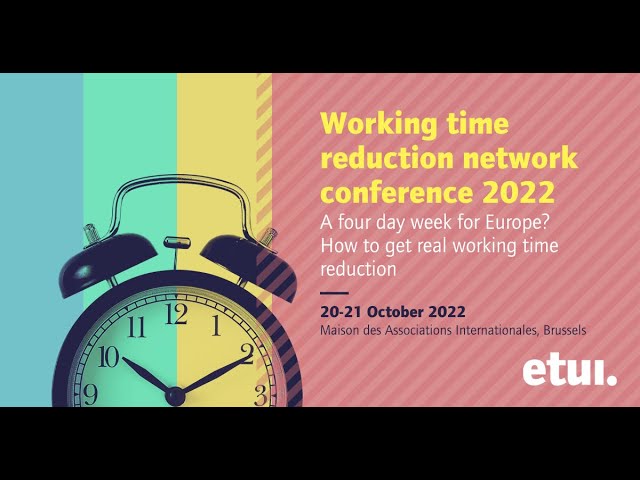
And on October 20-21st, the Network held a conference on the possibility and impact of a four day week for Europe.
8. Webinars launched & formal registration
In March 2023, the European Work-time Network was formally registered in France as a non-profit organization.
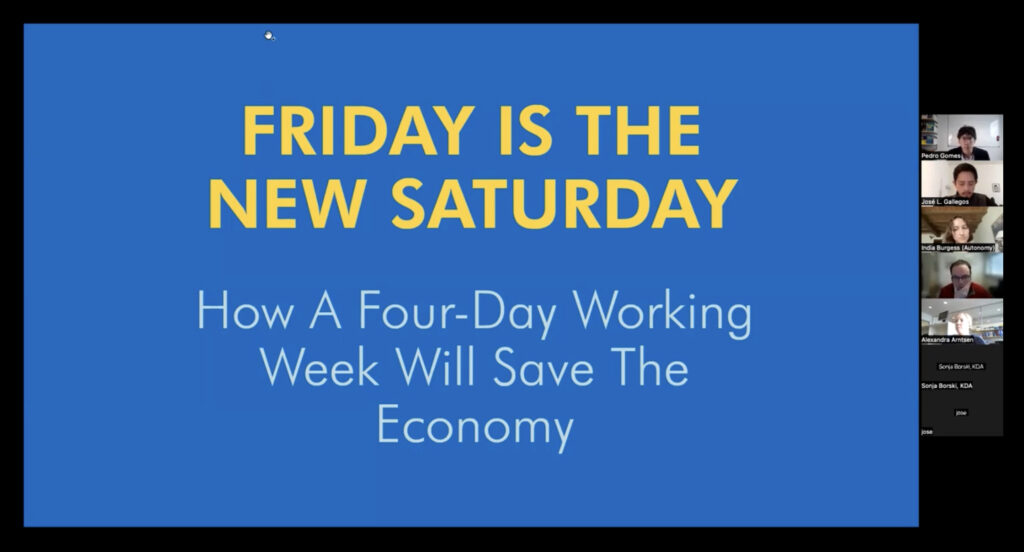
In 2023, the Network started it’s webinar series. Over the next few years, it would host over 15 webinars online.

9. 2024 Conference
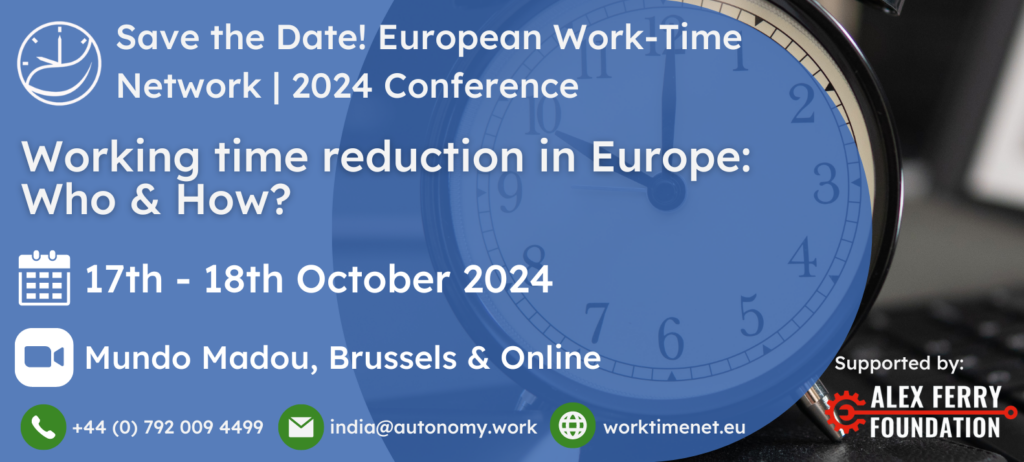
The Network held it’s third conference at Mundo Madou in Brussels on October 17th & 18th 2024.
The conference had a practical approach, examining concrete steps for reducing working hours, addressing implementation challenges, and identifying key drivers of this transformation.
10. 2025 Event in European Parliament
On November 20th 2025, The European Work-Time Network participated in a special event in the European Parliament.
This public event, which was hosted by the EFA-Green Group in European Parliament and supported by the European Work-Time Network, brought together researchers, trade unions, civil society, and policymakers to explore the promise of working time reduction as a path toward more meaningful work, sustainability, and economic justice.